
Touchless login, secure AI scribing and staff safety for hospitals
Crayonic Badge™ is a FIDO2-certified, security-first wearable that clinicians wear all shift. It gives them presence-based touchless login and logout on shared workstations, records consultations for AI documentation with end-to-end encryption, opens doors, receives critical alerts, and calls for help with one press. One certified, EU-made device replaces passwords, smart cards, pagers, panic buttons, dictation microphones and extra ID cards.
Book a Demo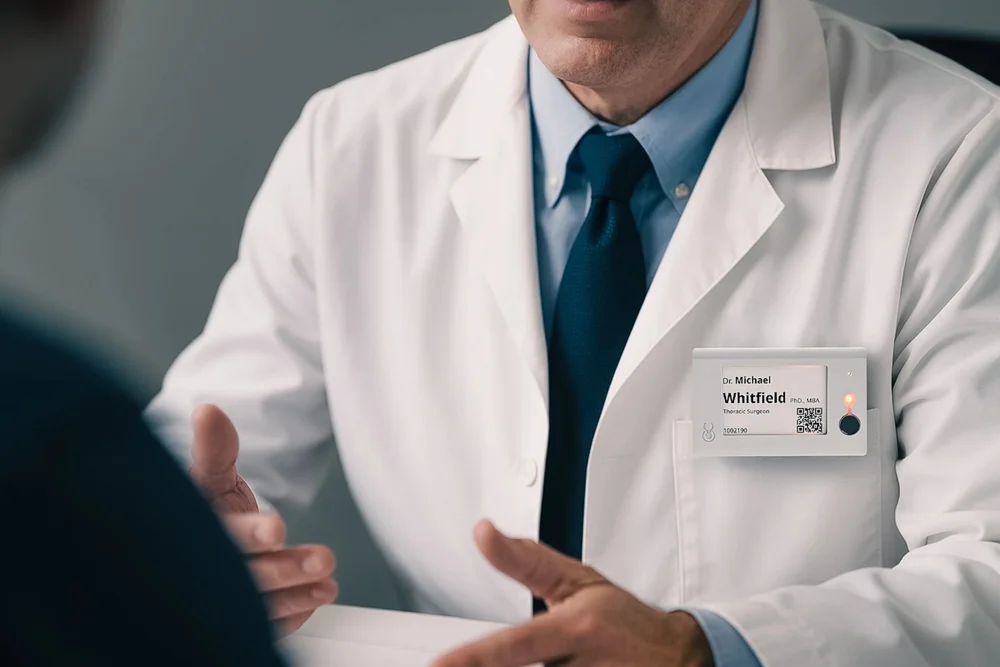
The problem: clinical time lost to logins, and data left exposed
Clinicians log in to shared workstations dozens of times a shift. Passwords get shared or stay logged in, sessions get left open, and every typed password is an opening for phishing and ransomware, which hit hospitals across Europe hard. Documentation takes hours away from patients, and many dictation and AI-scribe tools send sensitive conversations through phones and cloud services nobody controls.
One device on every clinician
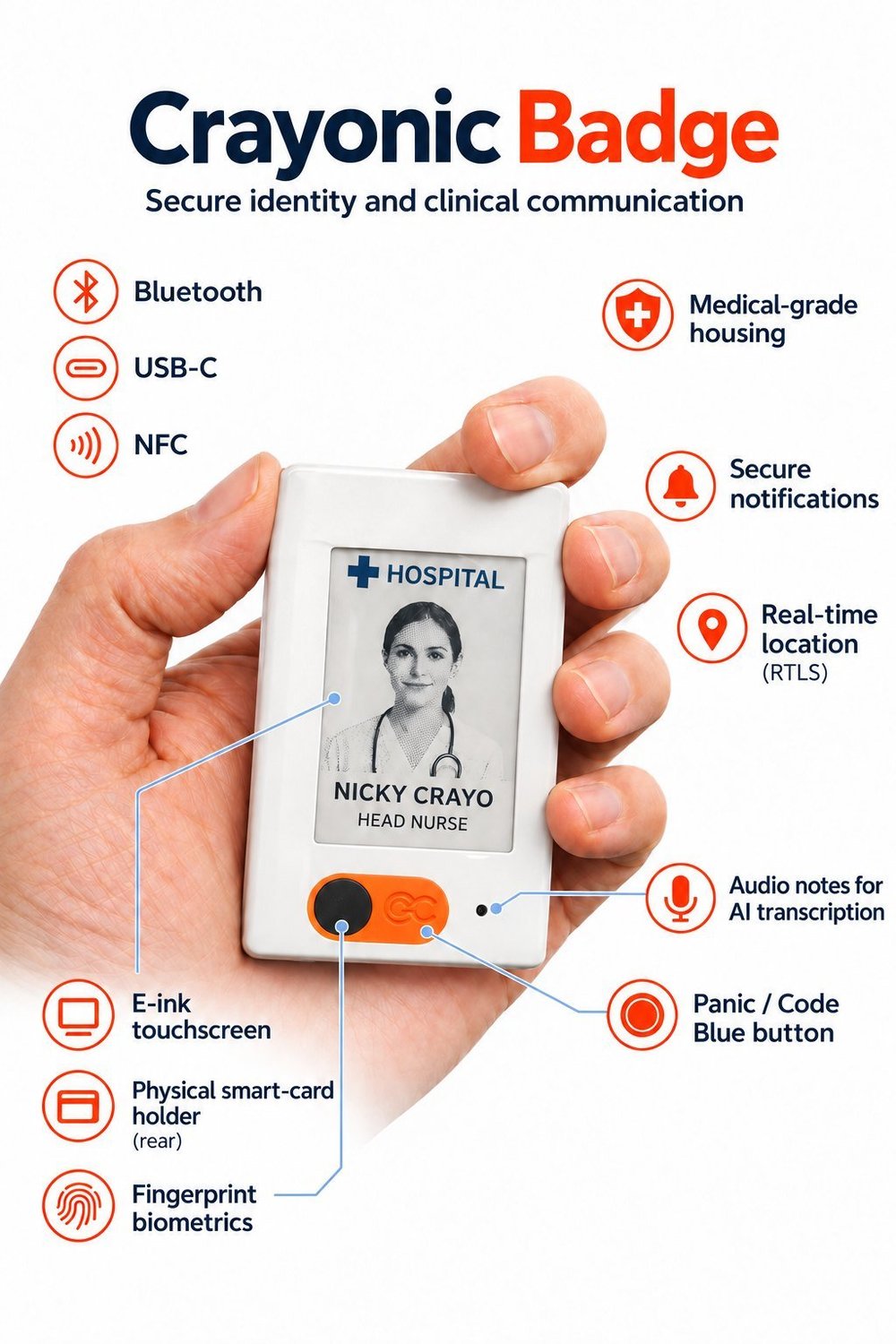
The Badge is worn like a normal hospital ID, but it does far more.
- E-ink touchscreen: an ID that is always relevant, plus alerts, pages and the PIN entry pad.
- Fingerprint biometrics: re-verifies you whenever the Badge is unsure who is wearing it, for example after it was left on a desk and locked.
- Bluetooth, NFC and USB-C: presence-based touchless workstation login, door access and charging.
- Panic / Code Blue button: one press calls for help and shares your location through RTLS.
- Microphone: encrypted audio notes for Secure AI Scribe documentation.
- Smart-card holder (rear): keeps your existing access, ID or smart card working.
- Cleanable housing: IP64 water-resistant and compatible with hospital cleaning agents.
Benefits for clinical teams

Presence-based touchless login/logout
Clinicians are logged in automatically when they approach a shared workstation wearing their Badge, and logged out when they walk away. The Badge has to be physically near the workstation, so nothing needs to be touched or typed. Where only an NFC reader is installed, a quick tap works like a smart card.

Crayonic Secure Scribe
Record consultations on the Badge with end-to-end encryption. AI turns them into clinical notes that the clinician reviews and signs into the EHR under their own identity.

Critical alerts and secure paging
Critical results, pages and shift updates arrive on the Badge's e-ink screen with a buzzer, which lets you retire legacy pagers.

Panic / Code Blue button
One press raises the alarm and shares the wearer's location through compatible RTLS services, protecting staff from violence and speeding up emergency response.

Infection control and contact tracing
Indoor location data shows who was near an infected patient, where and for how long, so teams can contain outbreaks quickly.

Physical access, ID and e-signing
Carries the staff photo ID or access card in its back slot, opens doors by proximity or NFC, and signs clinical documents with high assurance.
How Secure Scribe protects patient conversations
- The clinician records the consultation on the Badge. Audio is encrypted from the moment words are spoken, with a key derived from the clinician's own Badge.
- The clinician authenticates in the Secure Scribe app with the Badge. Only then can the audio be decrypted for transcription.
- AI drafts the clinical note through a compatible medical speech-to-text and AI service.
- The clinician reviews and edits the audio, raw transcript and AI note, then pushes it to the right patient record in the EHR under their own identity.
- Recordings are wiped automatically after the period your policy sets. Without the clinician's Badge, the encrypted audio cannot be read.
Compliance and data protection
| Requirement | How Crayonic helps |
|---|---|
| NIS2 (healthcare is an essential sector) | Phishing-resistant multifactor authentication for data and physical access, with an audit trail in Crayonic Device Manager and SIEM integration. |
| GDPR and patient confidentiality | End-to-end encrypted recordings that only the clinician's Badge can decrypt, policy-based auto-deletion, and fingerprints stored only inside the Badge. |
| HIPAA (for US-regulated organizations) | Unique user identification, automatic logoff, and access audit for shared clinical workstations. |
| Data sovereignty | Device and credential management can run fully on-premises, and the hardware is manufactured in the EU. |
| Staff safety duties | Panic button and location-aware alarms for lone and at-risk staff. |
Full compliance also depends on your wider policies and systems.
Fits your hospital IT
Microsoft Entra ID and Active Directory
FIDO2 passkeys register directly in Entra ID for Windows and Microsoft 365 sign-in. Crayonic Credential Manager adds self-service enrollment and recovery.
EHR and clinical apps
Secure Scribe delivers notes into your EHR, and the Badge works with any app that supports Windows or web sign-in.
Works offline
Authentication runs on the device and on local infrastructure, so clinical login keeps working during internet or cloud outages.
Built for the ward
IP64 water-resistant, compatible with cleaning agents, weeks of battery life, and an e-ink screen that stays readable all shift.
Frequently asked questions
How does touchless login work for clinicians?
A small Crayonic Bridge on each workstation connects to the Badge over secure Bluetooth and defines a presence zone around it. The clinician unlocks the Badge with a PIN on its own screen or a fingerprint. While the Badge stays on their body, its on-body sensor and continuous motion monitoring keep confirming it is the same person, so they are logged in on entering the zone and logged out on leaving it, without touching anything. If the Badge is taken off or left on a desk, it locks and asks for a fingerprint or PIN again. Fully touchless operation suits operating rooms and private offices with a single PC; where only an NFC reader is installed, the Badge is tapped like a smart card.
Is Secure Scribe safe for patient data?
Yes. Audio is encrypted end-to-end with a key derived from the clinician's own Badge, can only be decrypted after the clinician authenticates, and is wiped automatically after the period your policy sets. The clinician reviews every note before it reaches the patient record.
Can the Badge replace pagers?
Yes. The Badge receives critical alerts, secure pages and calendar updates on its e-ink display with an audible buzzer, so hospitals can retire separate paging devices.
Does the Badge help hospitals meet NIS2?
It provides phishing-resistant multifactor authentication for both data and physical access, with a full audit trail. These are core NIS2 controls for essential entities such as hospitals.
Can the Badge be cleaned between patients?
Yes. The body is IP64 water-resistant and compatible with standard hospital cleaning agents.
Pilot the Badge on a ward
Start with one ward or department: touchless login, Secure Scribe and staff safety, managed centrally.
Book a DemoExplore Crayonic BadgeAlso see: Banking & Finance · Manufacturing · Defense