
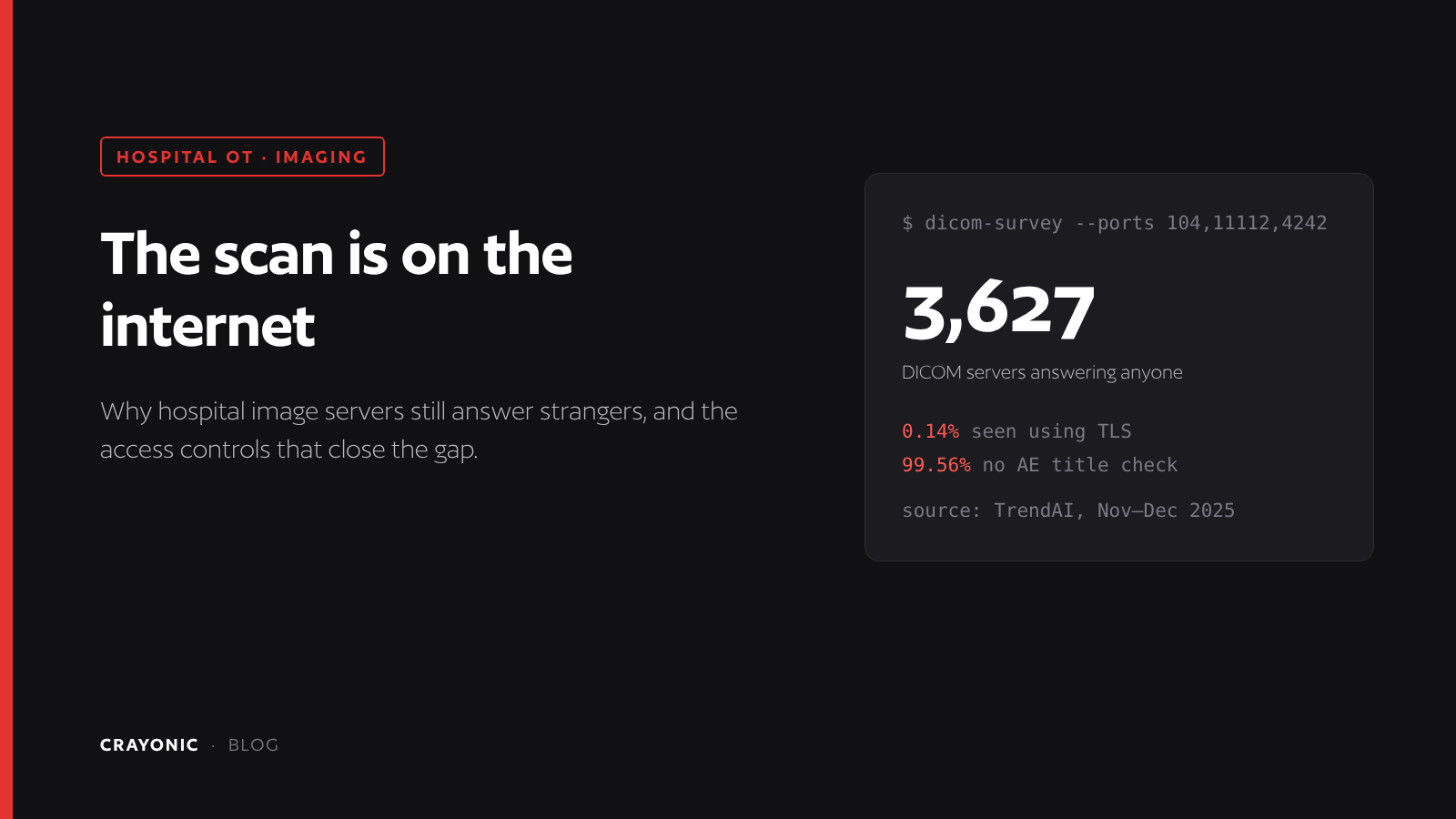
DICOM, the standard every scanner and image archive speaks, has supported encryption since 1999. Yet when researchers at Trend Micro's TrendAI team scanned the internet between November and December 2025, they found 3,627 DICOM servers in more than 100 countries answering anyone who asked. Only 0.14% were seen using TLS. 99.56% accepted connections without even checking the caller's application entity (AE) title, the closest thing the protocol has to a name badge.
This is not a new finding. It is a finding that will not go away.
Seven years of the same headline
In 2019, Greenbone counted 1.19 billion medical images freely reachable online. In December 2023, Aplite presented research at Black Hat Europe showing 3,806 exposed DICOM servers holding data on 59 million patients, and "just 1%" had implemented the protocol's authentication and authorisation mechanisms. Censys, in October 2024, found that DICOM servers made up 36% of all exposed healthcare systems it could see, plus 2,530 PACS login portals facing the public internet.
The counts move up and down with method. The pattern does not: image archives reachable from anywhere, with little or no check on who is asking.
Why imaging leaks
Three things combine.
The security is optional. The DICOM standard's own security page is blunt: "DICOM merely facilitates the use of encryption but does not mandate it." Whether to use it, it says, "is a policy choice of the health facility and an implementation choice of the product vendor." The current TLS profile requires servers that claim it to support mutual authentication, though they may switch it off, and nothing forces anyone to claim the profile.
The identity is weak. In practice, many PACS decide who may connect by AE title, a short text label that any client can set to anything. That is configuration, not authentication.
The defaults are generous. In February 2025, CISA warned that the widely used open-source Orthanc server, before version 1.5.8, did not enable basic authentication by default when remote access was turned on. One of the researchers credited in the advisory told SecurityWeek he had seen 615 exposed instances. Other 2025 advisories, for OsiriX MD and Sante PACS Server, included web portals that sent login credentials without encryption. In April 2026, CERT/CC disclosed a further set of Orthanc flaws that could, under some conditions, allow remote code execution.
Add the way imaging grew up: modalities, reading-room workstations, teleradiology links and cloud viewers, each added by a different project, often by a vendor with remote access of its own. Imaging sits somewhere between IT and operational technology, and in many hospitals nobody owns its perimeter end to end.
What it costs
The bill arrives late. Northeast Radiology in the US had a PACS server whose images could be viewed by people without authorisation between April 2019 and January 2020; 298,532 patients were affected. The US health regulator settled for $350,000 in April 2025, more than five years after the exposure began. In France, the data protection authority fined two doctors €3,000 and €6,000 in December 2020 after patient scans were left reachable without proper access protection, in one case for about five years.
In the EU, NIS2 lists access-control policies and, where appropriate, multi-factor authentication among the risk-management measures expected of healthcare providers (Article 21(2)(i) and (j)). As national laws take effect, an exposed archive becomes a governance question as well as a privacy lapse.
Five things to check this quarter
Find every DICOM listener. Scan your own address space, internal and external, on ports 104, 11112, 4242 and 2762 (DICOM over TLS), and the web viewers in front of them, such as Orthanc's default port 8042. Compare with your asset register. Do the same for cloud tenants your vendors run on your behalf.
Take DICOM off the internet. The HHS alert on PACS advises placing PACS behind a firewall whenever possible and requiring a VPN to reach it, as well as patching promptly and enabling HTTPS. Aplite's researchers recommended making sure DICOM endpoints are not publicly visible on the internet at all.
Segment by role. NIST's PACS reference architecture (SP 1800-24) recommends network zoning and microsegmentation for finer control of traffic to and from the archive, and certificate-based authentication for imaging devices and clinical systems.
Authenticate people, not labels. Web viewers and teleradiology portals should sit behind the same identity provider as the rest of the hospital. NIST SP 1800-24 calls for multi-factor authentication for care providers. We would go further: make it phishing-resistant, and apply it to vendor engineers as well as radiologists.
Turn on what the standard already offers. Use the DICOM TLS profile with mutual authentication where modalities support it, log access in line with the IHE ATNA profile, and patch the archive and viewers like any other internet-adjacent server. Write these requirements into the next imaging procurement.
None of this needs new technology. It needs someone to decide that the image archive is a front door, not a cupboard, and to lock it like one.
